Edmund Burke's statue in Bristol's city centre.
During one of our group presentations on Wednesday 17th March, Aaron Francis made some interesting comments about the sublime in relation to , which he and the other full time MA students had discussed in the visual cultures unit. It encouraged me to blog about it and consider its connections with my own imagery. Thank you Aaron.
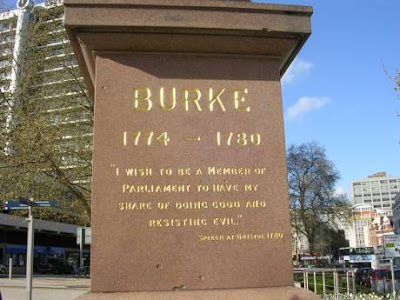
"I wish to be a Member of Parliament to have my share of doing good and resisting evil"
Chris Baldick described the sublime as “a quality of awesome grandeur in art or nature, which some 18th-century writers distinguished from the merely beautiful”. Baldick suggests that an anonymous Greek critical treatise of the 1st century AD, Peri hypsous “provided the basis for the interest in the sublimity, after Boileau’s French translation in 1672” (1991 p. 215).
This new aesthetic concept of the 1700s “anticipated the Romantic sensibility that followed… The key work on the concept in English was Burke’s Philosophical Enquiry into the Origin of our Ideas of the Sublime and Beautiful (1757) which stressed the power of the Sublime to evoke terror and ‘the grander passions’ ” (Thomas, 1981, p. 174). (Burke misattributes Peri hypsous to a 3rd century rhetorician Longinus).

Giovanni Battista Piranesi Carceri Plate VII - The Drawbridge 1750-61
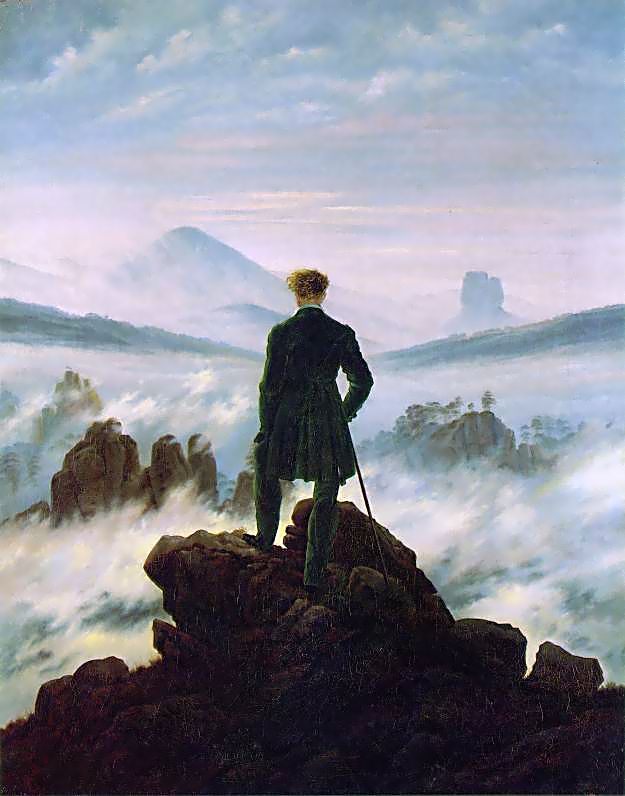
Burke describes the sublime as having these characteristics: obscurity, vastness and power, while the beautiful is light, smooth and delicate. Burke's theories provided the vocabulary to describe the work of Piranesi and later the work of Casper David Friedrich and Turner.
Casper David Friedrich The Wanderer above a Sea of Mist 1818

J.W.M. Turner, Shade and Darkness - The Evening Before the Deluge, 1843

J.M.W. Turner, The Morning after the Deluge — Moses Writing the Book of Genesis, 1843
The term Abstract Sublime was used by the American critic Robert Rosenblum in 1961 in reference to paintings by certain members of the New York School. Having been influenced by Edmund Burke, Barnett Newman employed the word ‘sublime’ in connection with his own work from 1948. Rosembum made connections between the similarities between paintings of the sublime in nature by such Romantic Movement artists as James Ward, Casper David Friedrich and J. M. W. Turner and paintings by Jackson Pollock, Clyfford Still, Mark Rothko and Newman (Walker, J.A. 1991)

Barnett Newman - Vir Heroicus Sublimis 1950-51

Marth Rothko: The Rothko Chapel, Houston 1965-66
Bibliography:
Baldick, C (1991) The Concise Oxford Dictionary of Literary Terms Oxford and New York: Oxford University Press
Thomas, D (1981) Dictionary of Fine Arts London and New York: Hamlyn
Walker, J. A. (1991) Glossary of Art, Architecture & Design Since 1945 Boston, Massachusetts: G.K. Hall& Co.
 The Monk by the Sea, 1808-1810
 The Abbey in the Oakwood 1808–10
 The Chasseur in the Forest, 1814
 The Evening, 1820-21
 Moonrise Over the Sea 1822
 The Tree of Crows
 The Sea of Ice 1823–24
 The Oak Tree in the Snow 1829
 Man and Woman Contemplating the Moon, 1830–35
 Seashore by Moonlight, 1835–36