Showing posts with label Art History. Show all posts

Wednesday, 5 May 2010

Edouard Manet: Un Bar aux Folies-Bergère (1882)

Un Bar aux Folies-Bergère (1882)

Manet’s last painting Un Bar aux Folies-Bergère (1882) is a fascinating modern painting. Its relevance here was at first unclear to me. Ever since we discussed modernism in the Media Technologies and Public Spheres unit, it has been recurring in my thoughts.

T. J. Clark made reference to the criticisms of the painting: it “was held to be badly drawn and insubstantial”, while “the light was ‘indecisive’, ‘bluish, (and) murky’, the glass and reflection were hopelessly botched” (Clark, T.J. 1985, p.240). There is a “general haze and dazzle” (
1985, p.249) which provides us with a fascinating atmosphere. Clark quotes the critic Jules Comte’s description of the painting: “the bar and the room are lit by two globes of electric light, that white blinding light that we all know; but Monsieur Manet has probably chosen a moment when the lamps were not working properly, for never have we seen light less dazzling; the two globes of polished glass have the look of lanterns glimpsed through a winter’s fog” (1985, p.240).

The paintings softness and blackness is described by Gilbert-Rolfe in his essay “Edouard Manet and the Pleasure Problematic”. When it comes to the light, he suggests that within the Bar “the hardness and reflectiveness (invisibility) provide a space for blurring and bursts and orbs of light brighter than the light of the painting as a whole, but which is shown to be the source of that light” (Gilbert-Rolfe, 1995 pp.3-4).


Bibliography:


Clark, T.J., (1985)
The Painting of Modern Life: Paris in the Age of Manet and His Followers, London: Thames and Hudson

Gilbert-Rolfe, J., (1995) “Edouard Manet and the Pleasure Problematic” in
Beyond Piety: Critical Essays on the Visual Arts 1986-1993, Cambridge, New York and Melbourne: Cambridge University Press, pp.3-12.

Gilbert-Rolfe, J., (1995) Beyond Piety: Critical Essays on the Visual Arts 1986-1993, Cambridge, New York and Melbourne: Cambridge University Press.


Monday, 5 April 2010

Picasso's Collages


Pablo Picasso Guitar, Sheet Music, and Wine Glass 1912


As I work on my digital collages I am reminded of Clement Greenberg's essay on collage: "The Pasted-Paper Revolution" (or as it is known "On Collage"). Greenberg's article is still amazing. In it he discusses a number of cubist works by Braque and Picasso.

In the Autumn of 1912 Pablo Picasso began a series of works using a range of materials such as wallpaper, imitation wood grain, newspaper, a charcoal drawing
and sheet music. This is one (above) of the earliest collages and perhaps even the first.

Clement Greenberg in his "The Pasted-Paper Revolution" of 1958 argued that pictorial allusion gave way to what he called an optical illusion. In his sophisticated formalist reading of the work he argued that the various elements, the lettering, the charcoal lines and the coloured papers "begin to change places in depth with one another, and a process is set up in which every part of the picture takes its turn at occupying every plane, whether real or imagined, in it."


Art News 1958

Source:

Frascina, Francis and Harrison, Charles (1987) Modern Art and Modernism: A Critical Anthology New York: Harpers and Row pp.105-108.

Monday, 29 March 2010

Abstract Cinema 7: Norman McLaren


"For myself, indeed, with an abstract film, the most pleasing forms are those which come closest to music. There must be visual equivalence"
Norman McLaren.

The above film Begone Dull Care (1949) was produced partly through the painting of the visuals onto 35mm clear film, frameless and frame by frame. Other imagery were etched directly into 35mm film.

The film features a soundtrack by Oscar Peterson


Abstract Cinema 6: Harry Smith


— Short animations by Harry Smith.
No. 1: A Strange Dream (l946)
No. 2: Message from the Sun (1946-48)
No. 3: Interwoven (1947-49) (Part 1)


Abstract film, especially where colour is concerned owes a lot formally to the work of Kandinsky. Malcolm Le Grice makes some interesting comparisons between works like The Battle from 1910 and Harry Smith’s Film Number 3 done before 1950. "Kandinsky's work" argues Le Grice "not only explores the notion of shape transformations, or colour changes within repeated shapes, but also shape repetitions which imply movement either across the surface or into the 'space' of the picture" ( 1977, p.77).
 Further reading:

LeGrice, M. (1977) Abstract Film and Beyond, Cambridge, Mass and London: MIT Press.


Russett, R.and Starr, C. (1976) Experimental Animation: An Illustrated Anthology, New York: Van Nostrand.


Abstract Cinema 4: Oskar Fishinger


Above: Abstractions 1946-57.

Oskar Fishinger is often seen as the pioneer of abstract animation. Jerry Beck suggests that “Fishinger had always had a dream of blending classical music with the kind of conceptual designs that might be formulated in one’s mind when listening to a symphony. This mixture he termed as ‘visual music’” (Beck, 2004, p.22).

Fishinger’s ability in blending music with animation inspired the animators on Walt Disney’s Fantasia (1941). He did work on the “Toccata and Fugue” (Bach) section, but “because his original designs were dismissed as too abstract and modified against his wishes, Fishinger acquired a deserved reputation as an animator with more integrity than Disney” (Kostelanetz, 2001 p.213). Fantasia can be seen as “Disney’s attempt to legitimise the animated film by working in a more abstract, highly aesthetic supposedly ‘cultured’ way" (Wells, 1998 p. 29)


Further reading:

Beck, J., (2004) Animation Art: From Pencil to Pixel, The History of Cartoon, Anime and CGI London: Flame Tree Publishing.
Kostelanetz, R., (2001) Dictionary of Avant-gardes 2nd Edition, New York and London: Routledge.
Leslie, E., (2002) Hollywood Flatlands: Animation, Critical Theory and the Avant-garde, London and New York: Verso.
Russett, R.and Starr, C. (1976) Experimental Animation: An Illustrated Anthology, New York: Van Nostrand.
Wells, P., (1998) Understanding Animation London and New York: Routledge

A Note on Abstract Expressionism

Abstract Expressionism has been mentioned on a number of occasions throughout this blog. It is perhaps America’s stand against other media. The purity argued by Clement Greenberg is interesting, but at this moment I favour something anti-formalist.


I take pleasure in John Squire’s exuberant appropriation of Pollock or Ralph Rucci’s homage to Cy Twombly.

John Squire, Bye Bye Badman, 1988, oil on canvas


Cy Twombly Untitled 1970


"Twombly Swan" white silk gazar gown with embroidery and beading by Lesage
Chado Ralph Rucci, Ready-to-wear spring/summer 2002
Collection of Ralph Rucci


I am drawn to abstract expressionisms scale and grandness: scalessness? It is also its all overness that is also very effective in both painting and photography: a wholeness of gesture.


Saturday, 27 March 2010

Abstract Cinema 3: Hans Richter


Hans Richter is still an important chronicler of the Dada movement. His first-hand account of Dada, Dada: Art and Anti Art still stands today as an important document despite it’s the silly and appalling treatment of Hannah Höch. It’s a book that still appears on many a reading list in art schools today.


Hans Richter’s Rythmus 21 is an important early abstract film. It sometimes, quite wrongly apparently, referred to as the first abstract film.


According to Esther Leslie, Richter’s “abstract films were conceived as a light-play of positive and negative” (Leslie, 2002p.37). Leslie compares Richter to Malevich in his aim to “reduce form to its simplest element”, which Richter claimed “to be the rectangle or square” (p.37). However, she points out that unlike Malevich and others, there was no “assumed metaphysical importance” to these elements (p.37).


Sources:

Leslie, E., (2002) Hollywood Flatlands: Animation, Critical Theory and the Avant-Garde, London and New York: Verso.

Abstract Cinema 2: Viking Eggeling (1880-1925)


Eggeling was an early contributor to the Dada movement. In collaboration with Hans Richter he worked on abstract picture scrolls. The works are notable shift in (Zurich) Dada’s aesthetics away from Expressionism towards Constructivism. Although it can be argued that historically “the impetus for the production of the first abstract film seems to come from music and paintings rather than cinematography” stimulated by the “Blaue Reiter almanac’s call for a theory of painting” (Lynton, 2003, p. 119).

Eggeling was concerned with “‘rhythm in painting’ through all the possible permutations of certain linear and spatial relationships” (Kostelanetz, R., 2001, p. 189): “a general concern for line and surface” (Michaud, 1996, p.23). Above is the classic Diagonal Symphony from 1924, in which Eggeling produced more than a thousand drawings on his own.


Bibliography:

Kostelanetz, R., (2001) Dictionary of Avant-gardes 2nd Edition, New York and London: Routledge.

Lynton, N., (2003) The Story of Modern Art, London and New York: Phaidon.

Michaud, Philippe-Alain, (1961) “The Haunting of the Subject on Dada Cinema”, in (2005) Dada Cinema, Paris: Re: Voir Video.

Wednesday, 24 March 2010

Mark Rothko

Simon Schama on Rothko:

"One morning in the spring of 1970, I went into the Tate Gallery and took a wrong, right turn and there they were, lying in wait. No it wasn't love at first site. Rothko had insisted that the lighting be kept almost pretentiously low. It was like going into the cinema, expectation in the dimness. Something in there was throbbing steadily, pulsing like the inside of a body part, all crimson and purple. I felt I was being pulled through those black lines to some mysterious place in the universe. Rothko said his paintings begin an unknown adventure into an unknown space. I wasn't sure where that was and whether I wanted to go. I only know I had no choice and that the destination might not exactly be a picnic, but I got it all wrong that morning in 1970. I thought a visit to the Seagram Paintings would be like a trip to the cemetery of abstraction - all dutiful reverence, a dead end. Everything Rothko did to these paintings - the column-like forms suggested rather than drawn and the loose stainings - were all meant to make the surface ambiguous, porous, (and) perhaps softly penetrable. A space that might be where we came from or where we will end up. They're not meant to keep us out, but to embrace us; from an artist whose highest compliment was to call you a human being."
BBC:
http://www.bbc.co.uk/arts/powerofart/rothko.shtml


Black on Maroon, 1959


Rothko reached his mature style around 1949 and the early nineteen fifties. Rothko’s work features “large hand-shaped rectangles, usually staked one above the other, together filling nearly the entire field of the canvas”, with each rectangle having “slightly different hues, while the background color (sic) differs only a little more from that of the rectangles” (Kostlanetz, R., 2001 p.530). Rothko’s work can be seen as an important precursor to monochromatic painting that we have seen since the nineteen sixties and seventies, which explore “surface tensions, color (sic) relationships and ways of negating suggestions of ‘depth’” (p.530).

No 14, 1960.


Rothko was part of the “theological” wing of the abstract expressionists. He was “obsessed with the moral possibility that his art could go beyond pleasure and carry the full burden of religious meanings- the patriarchal weight, in fact, of the Old Testament” (Hughes, R., 1991 p.322-323). His attempt to fulfil this ambition culminated in a series of paintings from 1964-7, commissioned by the de Menil family as “the objects of contemplation” in a non-denomination chapel attached to Rice University (p. 323).


Centre Tryptich for Rothko Chapel, 1966, Houston


The monochromatic paintings have “all the world…drained out of them, leaving only a void”: the Rothko Chapel therefore represents "the last silence of Romanticism” (Hughes, R., 1991 p. 323).


Bibliography:

Hughes, R., (1991) The Shock of the New, London: Thames and Hudson.

Kostelanetz, R., (2001) Dictionary of the Avant-Gardes, New York & London: Routledge.

Schama, S. & BBC, Simon Schama on Rothko: Available from World Wide Web: http://www.bbc.co.uk/arts/powerofart/rothko.shtml [last accessed 24/03/10].


Braque


Le Guéridon


Le jour (1929)


L'Atelier III, 1949


The Classicism of Braque’s painting of the twenties and thirties and beyond are interesting for a number of reasons. The works “reactionary nature” is connected to Braque’s “collapse into calm” (Wheeler,D., p.64). The works representation of calm is partly due to the process of the “reassembly” of the still-life tradition that Cubism “helped to shatter” (Hughes, 1991 p. 146). His subject was the studio. For Braque “the studio is a sanctum, imagination’s cave, and its clutter of bottles, pots and oddities suggests the alchemists cell with its alembics and stuffed crocodile” (Hughes, 1991, pp. 146-49). The studio or at least the image of it is one of “a privileged place of transmutation, memory and contemplation… the key to the paintings of Braque’s old age, the Ateliers of 1949-54, with their calm transparency and baffling layers of images” (Hughes, 1991 p. 146).

A further discussion on Braque is available here.

Sources:
Hughes, R., (1991)
Shock of the New, London: Thames and Hudson.
Wheeler, D., (1991)
Art since Mid-Century, London: Thames and Hudson.

Thursday, 18 March 2010

The Sublime


Edmund Burke's statue in Bristol's city centre.

During one of our group presentations on Wednesday 17th March, Aaron Francis made some interesting comments about the sublime in relation to , which he and the other full time MA students had discussed in the visual cultures unit. It encouraged me to blog about it and consider its connections with my own imagery. Thank you Aaron.

"I wish to be a Member of Parliament to have my share of doing good and resisting evil"


Chris Baldick described the sublime as “a quality of awesome grandeur in art or nature, which some 18th-century writers distinguished from the merely beautiful”. Baldick suggests that an anonymous Greek critical treatise of the 1st century AD, Peri hypsous “provided the basis for the interest in the sublimity, after Boileau’s French translation in 1672” (1991 p. 215).

This new aesthetic concept of the 1700s “anticipated the Romantic sensibility that followed… The key work on the concept in English was Burke’s Philosophical Enquiry into the Origin of our Ideas of the Sublime and Beautiful (1757) which stressed the power of the Sublime to evoke terror and ‘the grander passions’ (Thomas, 1981, p. 174). (Burke misattributes Peri hypsous to a 3rd century rhetorician Longinus).


Giovanni Battista Piranesi Carceri Plate VII - The Drawbridge 1750-61

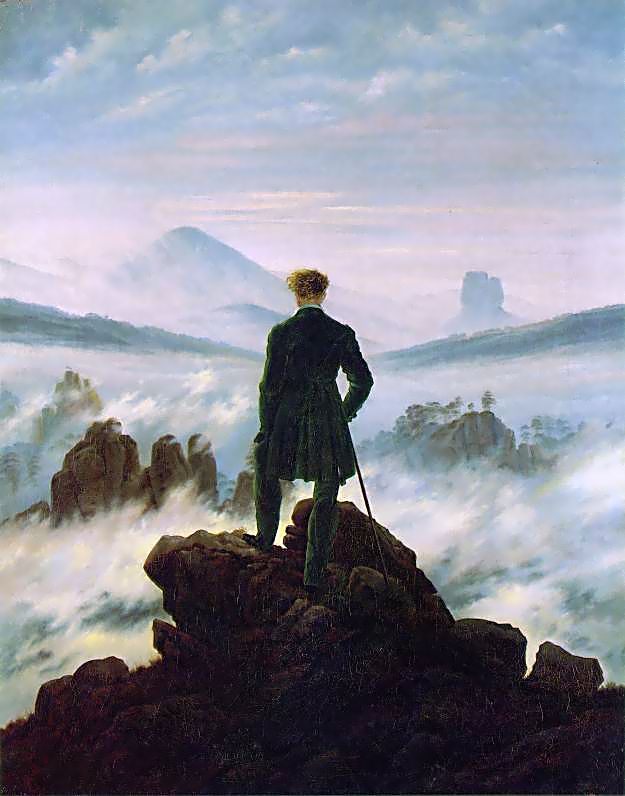
Burke describes the sublime as having these characteristics: obscurity, vastness and power, while the beautiful is light, smooth and delicate. Burke's theories provided the vocabulary to describe the work of Piranesi and later the work of Casper David Friedrich and Turner.

Casper David Friedrich The Wanderer above a Sea of Mist 1818


J.W.M. Turner, Shade and Darkness - The Evening Before the Deluge, 1843


J.M.W. Turner, The Morning after the Deluge — Moses Writing the Book of Genesis, 1843


The term Abstract Sublime was used by the American critic Robert Rosenblum in 1961 in reference to paintings by certain members of the New York School. Having been influenced by Edmund Burke, Barnett Newman employed the word ‘sublime’ in connection with his own work from 1948. Rosembum made connections between the similarities between paintings of the sublime in nature by such Romantic Movement artists as James Ward, Casper David Friedrich and J. M. W. Turner and paintings by Jackson Pollock, Clyfford Still, Mark Rothko and Newman (Walker, J.A. 1991)

Barnett Newman - Vir Heroicus Sublimis 1950-51


Marth Rothko: The Rothko Chapel, Houston 1965-66


Bibliography:

Baldick, C (1991) The Concise Oxford Dictionary of Literary Terms Oxford and New York: Oxford University Press

Thomas, D (1981) Dictionary of Fine Arts London and New York: Hamlyn

Walker, J. A. (1991) Glossary of Art, Architecture & Design Since 1945 Boston, Massachusetts: G.K. Hall& Co.


Sunday, 14 March 2010

Abstract Cinema 1: Walter Ruttman


Walter Ruttman is perhaps best known for his film Berlin: Symphony of a Great City from 1927, a film that demonstrated the influence of Soviet film montage as exemplified by Vertov. Before he produced this classic film Ruttman was making short abstract films in the early 1920s. Ruttmen like Eggeling and Richter started out as a painter. For these painters-come-film makers “it seems that at first, they hoped that animation could be, above all, paintings salvation rather than films” (Leslie, 2002 p.46).

Lightplay Opus I has been referred to as “not only the first abstract film to be shown in public, but also a film hand-tinted in striking and subtle colours, with a live synchronised musical score composed especially for it (Russett and Starr, 1976 p. 40).

In 1976 Opus I is said to be missing however above is a film which is claimed to be Opus I. It is claimed that “Ruttman did not wish it (Opus I) to be seen, after he had made improvements to his later films” (Russett and Starr, 1976 p. 40).

As well as producing his Opus films Ruttman produced abstract films for commercial purposes in Munich and Berlin: “in 1923 he created the “Dream of Hawks Sequence” for Fritz Lang’s Siegfried” (Russett and Starr, 1976 p. 41). Later he joined Lotte Reininger in her feature length silhouette animation The Adventures of Prince Achmed Ruttman produced fantasy effects using the wax slixcing machine he had commissioned from Oskar Fischinger. Prince Achmed was completed in 1926 after which Ruttmen gave up animation (Russett and Starr, 1976 p. 40).

Bibliography:


Leslie, E., (2002) Hollywood Flatlands: Animation, Critical Theory and the Avant-garde, London and New York: Verso.
Russett, R.and Starr, C. (1976) Experimental Animation: An Illustrated Anthology, New York: Van Nostrand.

Tuesday, 2 March 2010

Diebenkorn and Cezanne

"Cezanne is famous for saying that any idiot can make a deep space, that it is already deep, and that the task of the artist is to carve out that space- an oxymoron that exactly describes Cezanne's general practice" (Gilbert-Rolfe, 1995 p. 91)

Monday, 1 March 2010

Current Viewing

Apart from CSI, NCIS, Law and Order, Numbers, Criminal Minds, The Mentalist and TheEleventh Hour, I have been watching a lot of examples of avant garde film.

I was recently given a set of DVDs, one of which was a Dadaist film selection which included a number of Hans Richter abstract and semi representational film: Rythmus 21(1921-24), Filmstudie (1926) and Ghosts Before Breakfast (1927). The later two seem very surreal in nature. His one time collaborator Viking Eggeling also features on the DVD. His work Symphonia Diagonale (1921-24) is a purely abstract composition.

I also have a DVD of the work of Len Lye from 1935 to 1960/80. This is a really nice addition to my collection of animated films.

I need to prepare myself to watch Vertov's Man with a Movie Camera (1929). This is the film which served as a guide for Lev Manovich in his book The Language of New Media (2001).

Tuesday, 23 February 2010

A Beautiful Blog: The Art of Memory

This web blog contains an amazing group of imagery from Motherwell, Pollock to Rauschenberg and many others that I am unfamiliar with:

The Art of Memory

Richard Diebenkorn


Heidigger once described the brush stroke as an abyss suspended above the form. Derrida used this description to describe the line (Gilbert-Rolfe, 1995, p. 87).


Untitled, (The Ocean Park) , 1972
gouache on paper


Untitled (Ocean Park), by Richard Diebenkorn, ink, acrylic and graphite on paper, 29 by 21 1/4 inches, 1974


I have mentioned Diebenkorn once in a post in terms of the colour I applied to a painting that I subsequently scanned. The mixing of lamp black and Prussian blue is a mix of of colours used by Cezanne and Diebenkorn. Gilbert-Rolfe compared Diebenkorn to Cezanne and described the bluish black used by the two artists as the "deepest and most unfathomable colour available to the imagination, the colour of the night sky, colour of the bottomless pit" (1995 p. 87). Gibert-Rolfe in his description of Diebenkorn
Ocean Park drawings describes the lines as having a depth that is atmospheric and "a fathomlessness of blackness presented in the line". He goes on to say that the line acts as a "boundary " that "subdivides and organises through subdivision the uncertainty of atmosphere- as in the case with both drawing and writing in general, blackness bringing meaning to whiteness, night organizing day" (p. 90)


Gilbert-Rolfe, J. (1995) Beyond Piety: Critical Essays on the Visual Arts 1986-1993, New York and Cambridge: Cambridge University Press

Sunday, 21 February 2010

Cyberhistories: Cyberspace, Cyber Art and Cyberculture

If we look at the histories of digital media and the computer, we see the development begins somewhere during WWII, with Weiner and Vanevar Bush in America: the beginnings of the military industrial complex and in Britain with Alan Turing (although the computers development can be said to be much earlier).

Postwar we see digital pioneers from John and James Whitney to Benoit Mandelbrot. Computers can be seen as a creative and liberating force, a seductive and progressive idea reinforced by advertising campaigns that promote software such as Photoshop and hardware like the Apple Mac computer. Look at the way Apple promoted the Mackintosh computer. Generally, we see a shift from computers being viewed as part of a culture of calculation (as parodied by Rube Goldberg and Heath Robinson), seen in the examples of the machines designed by Charles Babbage or seen in Bletchley Park in WWII, and stereotypically PCs and Unix and command line environments, subject to hierarchy and centralised control (a tendency of Modernism) to one that includes the Internet and the WWW and emphasises a culture of simulation that is decentralised and fragmented (a tendency of Post-Modernism). The more recent digital and interactive design of John Maybury, Jenny Boulter and William Latham will bare witness to this ‘liberation’, as they themselves reveal the blurring distinctions between design practitioners and their practices and computer science. These are just of few of the professionals who have shaped the use of this fairly new medium, influenced art and designers and experimented and stretched the creative potential of these technologies.

Plato's Cave

Many texts on cyberspace and cyberculture seem to reference this story from Plato's famous book:

Book VII of The Republic
The Republic

Written 360 B.C.E

The Allegory of the Cave


[Socrates is speaking with Glaucon]

[Socrates:] And now, I said, let me show in a figure how far our nature is enlightened or unenlightened: --Behold! human beings living in a underground den, which has a mouth open towards the light and reaching all along the den; here they have been from their childhood, and have their legs and necks chained so that they cannot move, and can only see before them, being prevented by the chains from turning round their heads. Above and behind them a fire is blazing at a distance, and between the fire and the prisoners there is a raised way; and you will see, if you look, a low wall built along the way, like the screen which marionette players have in front of them, over which they show the puppets.

[Glaucon:] I see.


And do you see, I said, men passing along the wall carrying all sorts of vessels, and statues and figures of animals made of wood and stone and various materials, which appear over the wall? Some of them are talking, others silent.

You have shown me a strange image, and they are strange prisoners.

Like ourselves, I replied; and they see only their own shadows, or the shadows of one another, which the fire throws on the opposite wall of the cave?

True, he said; how could they see anything but the shadows if they were never allowed to move their heads?

And of the objects which are being carried in like manner they would only see the shadows?

Yes, he said.

And if they were able to converse with one another, would they not suppose that they were naming what was actually before them?

Very true.

And suppose further that the prison had an echo which came from the other side, would they not be sure to fancy when one of the passers-by spoke that the voice which they heard came from the passing shadow?

No question, he replied.

To them, I said, the truth would be literally nothing but the shadows of the images.

That is certain.

And now look again, and see what will naturally follow if the prisoners are released and disabused of their error. At first, when any of them is liberated and compelled suddenly to stand up and turn his neck round and walk and look towards the light, he will suffer sharp pains; the glare will distress him, and he will be unable to see the realities of which in his former state he had seen the shadows; and then conceive some one saying to him, that what he saw before was an illusion, but that now, when he is approaching nearer to being and his eye is turned towards more real existence, he has a clearer vision, -what will be his reply? And you may further imagine that his instructor is pointing to the objects as they pass and requiring him to name them, -- will he not be perplexed? Will he not fancy that the shadows which he formerly saw are truer than the objects which are now shown to him?

Far truer.

And if he is compelled to look straight at the light, will he not have a pain in his eyes which will make him turn away to take and take in the objects of vision which he can see, and which he will conceive to be in reality clearer than the things which are now being shown to him?

True, he said.

And suppose once more, that he is reluctantly dragged up a steep and rugged ascent, and held fast until he 's forced into the presence of the sun himself, is he not likely to be pained and irritated? When he approaches the light his eyes will be dazzled, and he will not be able to see anything at all of what are now called realities.

Not all in a moment, he said.

He will require to grow accustomed to the sight of the upper world. And first he will see the shadows best, next the reflections of men and other objects in the water, and then the objects themselves; then he will gaze upon the light of the moon and the stars and the spangled heaven; and he will see the sky and the stars by night better than the sun or the light of the sun by day?

Certainly.

Last of he will be able to see the sun, and not mere reflections of him in the water, but he will see him in his own proper place, and not in another; and he will contemplate him as he is.

Certainly.

He will then proceed to argue that this is he who gives the season and the years, and is the guardian of all that is in the visible world, and in a certain way the cause of all things which he and his fellows have been accustomed to behold?

Clearly, he said, he would first see the sun and then reason about him.

And when he remembered his old habitation, and the wisdom of the den and his fellow-prisoners, do you not suppose that he would felicitate himself on the change, and pity them?

Certainly, he would.

And if they were in the habit of conferring honours among themselves on those who were quickest to observe the passing shadows and to remark which of them went before, and which followed after, and which were together; and who were therefore best able to draw conclusions as to the future, do you think that he would care for such honours and glories, or envy the possessors of them? Would he not say with Homer,

Better to be the poor servant of a poor master, and to endure anything, rather than think as they do and live after their manner?

Yes, he said, I think that he would rather suffer anything than entertain these false notions and live in this miserable manner.

Imagine once more, I said, such an one coming suddenly out of the sun to be replaced in his old situation; would he not be certain to have his eyes full of darkness?

To be sure, he said.

And if there were a contest, and he had to compete in measuring the shadows with the prisoners who had never moved out of the den, while his sight was still weak, and before his eyes had become steady (and the time which would be needed to acquire this new habit of sight might be very considerable) would he not be ridiculous? Men would say of him that up he went and down he came without his eyes; and that it was better not even to think of ascending; and if any one tried to loose another and lead him up to the light, let them only catch the offender, and they would put him to death.

No question, he said.

This entire allegory, I said, you may now append, dear Glaucon, to the previous argument; the prison-house is the world of sight, the light of the fire is the sun, and you will not misapprehend me if you interpret the journey upwards to be the ascent of the soul into the intellectual world according to my poor belief, which, at your desire, I have expressed whether rightly or wrongly God knows. But, whether true or false, my opinion is that in the world of knowledge the idea of good appears last of all, and is seen only with an effort; and, when seen, is also inferred to be the universal author of all things beautiful and right, parent of light and of the lord of light in this visible world, and the immediate source of reason and truth in the intellectual; and that this is the power upon which he who would act rationally, either in public or private life must have his eye fixed.

Saturday, 20 February 2010