Showing posts with label Postmodernism. Show all posts
Showing posts with label Postmodernism. Show all posts
Thursday, 12 August 2010


Thursday, 13 May 2010
Is It Art, or Memorex?
This is a link to an article in Wired called Is It Art, or Memorex? by Reena Jana 21/5/01 discussing the work of Net artist Michael Mandiberg. Mandiberg's "art prank" was to "reproduce" Sherrie Levines reproductions of Walker Evans work and presents them as his own: a simulation of a simulation.
Mandiberg posted his photos on two websites he created: AfterSherrieLevine.com and AfterWalkerEvans.com.
Posted using ShareThis
Mandiberg posted his photos on two websites he created: AfterSherrieLevine.com and AfterWalkerEvans.com.
Wednesday, 28 April 2010
Tracy and the Plastics
— Excerpts from the performance titled "World" from 2004.
I like Jared's description of "them" as a cross between Bikini Kill and Devo!
I like Jared's description of "them" as a cross between Bikini Kill and Devo!
Sunday, 14 March 2010
Photography and Simulation: 1
I have already described and explained I think the nature of simulation as discussed by Dr Dean Lockwood in his lecture ‘Is it Life or is it Memorex?’: What is Simulation? Okay, so to some extent I have described it. See the entry for Digital Culture: 5.
I wish to talk briefly about simulation and photography. Although simulation is association with digital photography and other imagery made via the computer my examples are “originally” printed on paper via the use of a chemical process and the use negatives, again produced via a chemical process- or are at least made to seem so.
By the 1970s modernist ideas about authorship, innovation, experimentation, progress and originality were being challenged by post-modernism. Post-modernism considered art and photography amongst other forms of communication differently. Photography was now going to serve a “larger system of social and cultural coding” (Cotton, Charlotte, 2004 p. 191). The post-modernists, certainly Cindy Sherman and Sherrie Levine “became acutely aware that to present an image out of context is to alter that image forever” (Wheeler, D 1991, p. 311).
 Sherman, Cindy. Film Stills Series.

 Caravagio Self-Portrait as Sick Bacchus
1593-1594.
 Richard Prince Untitled [cowboy] 1980-84
Richard Prince came to prominence in the late nineteen seventies as an appropriator of mass culture. In 1980 he began to re-photograph Malboro cigarette adverts. By re-representing and cropping the familiar imagery, cutting out the text, isolating elements and placing the image within the context of a gallery setting, Prince seems to be reflecting on American iconography and forces the viewer to re-read a mythical representation of the American west. Traditionally signs are taken in all at once by a viewer. We do not inspect advertisements like we may inspect an oil painting. Prince in re-contextualising the image may wish to attempt to slow down the eye and the pace we look at the visual.

 Paul Strand, White Fence 1916


 Helmut Newton, Here they Come! 1981
Jemima Stehli, After Helmut Newton’s Here They Come! 1999 is a critique of Helmut Newton’s Here they Come! (1981). This remaking of an iconic image emulates Newton’s style and the pose of one of the models, but Stehli’s authorship is evident by the inclusion of the shutter release cable. The critique uses a similar approach to Sherman’s in that she becomes both the subject and object of the work challenging the objectification and stereotyping of women.
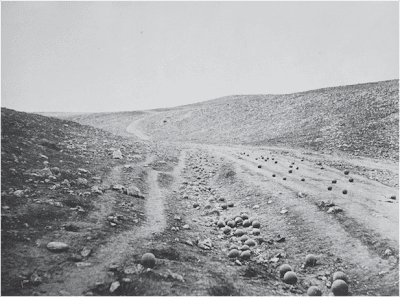 Roger Fenton, The Valley of the Shadow of Death, 1855. The Royal Collection c. 2005.
 Paul Seawright, Valley, 2002. Kerlin Gallery
An Overview:
By the 1970s modernist ideas about authorship, innovation, experimentation, progress and originality were being challenged by post-modernism. Post-modernism considered art and photography amongst other forms of communication differently. Photography was now going to serve a “larger system of social and cultural coding” (Cotton, Charlotte, 2004 p. 191). The post-modernists, certainly Cindy Sherman and Sherrie Levine “became acutely aware that to present an image out of context is to alter that image forever” (Wheeler, D 1991, p. 311).
 Sherman, Cindy. Film Stills Series.
1978-1980.
Cindy Sherman produced a long series of photographic simulations the Untitled Film Stills series in 1978. Described by Sherman as “one frame moving making” (Wheeler, D 1991, p. 326), this series drew from B-movies and on a whole repertoire of female stereotypes. These pictures are not just pastiches of a generic type of visual image, but operate as a critique of the cultural codes that construct femininity in our culture. Sherman condenses the role of model and photographer and as Charlotte Cotton says “she both observer and observed” (2004, p.193). Her work raises many issues to do with the representation of women: for who are the representations we see on a daily basis for? Femininity can be described as performative. Sherman appears playing with multiple images of female-ness, seemingly revealing that that the post-modern self and all identities are equally artificial and constructed. This seems to support Judith Butler’s reading of gender as performance (Ward, P 2003 pp. 133-136).

Cindy Sherman Untitled #224 1990
 Caravagio Self-Portrait as Sick Bacchus
1593-1594.
Sherman’s work moved from black and white film to Cibacrome colour and expanded her repertoire. In the late eighties and early nineties Sherman abandoned popular culture and focused upon art history, “decking herself out as subjects, male as well as female, in paintings from the “schools” of such Old Masters as Holbein, Watteau, Goya” and above, Caravaggio. Here she plays Carravagio, “playing” dress-up as the sick Bacchuss (Wheeler, D 1991, p. 326). Sherman helps to enlarges photography’s history by including “styles preceded the camera’s invention, a medium whose democracy is reflected in Sherman’s oeuvre, where social and aesthetic hierarchies crumble as the artist explores with equal interest a great dispersion of differences among genres and idioms” (Wheeler, D 1991, p.326). Sherman’s work seems to reflect the fragmentary and mediated nature of our culture, society and our experience.
 Richard Prince Untitled [cowboy] 1980-84
Richard Prince came to prominence in the late nineteen seventies as an appropriator of mass culture. In 1980 he began to re-photograph Malboro cigarette adverts. By re-representing and cropping the familiar imagery, cutting out the text, isolating elements and placing the image within the context of a gallery setting, Prince seems to be reflecting on American iconography and forces the viewer to re-read a mythical representation of the American west. Traditionally signs are taken in all at once by a viewer. We do not inspect advertisements like we may inspect an oil painting. Prince in re-contextualising the image may wish to attempt to slow down the eye and the pace we look at the visual.

Levine, Sherrie. After Walker Evans.
1980.
Even starker than Prince in her approach to re-photography is Sherrie Levine. Notoriously she re-photographed reproductions of famous male photographers: Rodchenko, Edward Weston and Walker Evans (above). Levine exhibited the work as her own in an “assertion that all art, far from being autonomous, is the product of history, memory and culture” Levine cited Roland Barthe in her defence: “a picture is a tissue of quotations drawn from innumerable centres.” Edward Weston for example had copied Greek sculpture in his photographs of his young son’s torso (Wheeler, D 1991, p. 326-327). These works and Levine’s other appropriations are a critiques of patriarchal notions of authorship and genius, of modernist ideas of originality, innovation and skill-- perhaps all patriarchal constructions.
Susan Lipper Untitled 1993-98
 Paul Strand, White Fence 1916
Susan Lipper’s descriptions of small town America draw upon the heritage of its representation within the context of documentary photography. Lipper seeks out and finds in contemporary places connections with potentially an archive of pre-existing imagery. Untitled 1993-98 makes a formal reference to the work of the American photographer Paul Strand (1890-1970) and specifically The White Fence (1916) which Charlotte Cotton describes as a photograph that embodies “ a key moment in photography’s modernist history” (2004, p.214-5).


Zoe Leonard and Cheyl Dunne, The Fae Richards Photo Archive 1993-96
The above imagery by Zoe Leonard and Cheryl Dunye, is their attempt to reclaim and challenge official history, and construct positive representations of the marginalised. Fae Richard’s (1908-73) “is a celebrated African-American Hollywood actress and singer” invented by Leonard and Dunye (Campany, D 2003, p. 60-1). The Fae Richard’s Photo Archive 1993-6 sees the artistic appropriation of visual styles and cultural stereotypes in an attempt to blur the distinctions between pastiche and the real. These careful forgeries are constructed in such a way to seem authentic and challenge the “clichéd tragedies of the lives of infamous black singers and performers” that dominate collective cultural memory with a representation of a successful black lesbian who was creative, affluent and happy (Cotton, C 2004, p.198-9).

Jemima Stehli, After Helmut Newton’s ‘Here They Come', 1999

 Helmut Newton, Here they Come! 1981
Jemima Stehli, After Helmut Newton’s Here They Come! 1999 is a critique of Helmut Newton’s Here they Come! (1981). This remaking of an iconic image emulates Newton’s style and the pose of one of the models, but Stehli’s authorship is evident by the inclusion of the shutter release cable. The critique uses a similar approach to Sherman’s in that she becomes both the subject and object of the work challenging the objectification and stereotyping of women.

 Roger Fenton, The Valley of the Shadow of Death, 1855. The Royal Collection c. 2005.
 Paul Seawright, Valley, 2002. Kerlin Gallery
Paul Seawright's imagery connects with moments in history. His image of the Valley from 2002 is part of a series called Hidden commissioned by Imperial War Museum in response to the conflict in Afghanistan. We do not exactly witness here scenes of conflict, but of the aftermath of battle. Commentators have noted that these pictures “draw us to these edges or fringes of things” and show us “photographs of scenes when the photographer is too late” (Lister, M 2007 p. 259). These photographs seem to pay homage to Roger Fenton’s (1819-69) war photography from the Crimea. This is an example of contemporary world events being mediated through pre-existing image-making.
An Overview:
Modernism, key ideas:
– Experimentation
– Innovation
– Individualism
– Progress
– Purity
– Originality
Post-modernism, key ideas:
– Appropriation or Simulation (see the ideas of Jean Baudrillard) is one approach by image makers
– Hyperrealism
– Questions ideas of originality, authenticity, authorship and skill and anything else on the previous list.
– Pastiche
– Parody
– The Art of Quotation
– Postmodern Art and Visual Culture largely informed by the work of:
– Marcel Duchamp (1887-1968) and the art movement Dada (1915-1924)
– Walter Benjamin (1892-1940) and his essay The Work of Art in the Age of Mechanical Reproduction (1935). Influences John Berger’s Ways of Seeing Chapter 1 Episode 1 (1972)
– Andy Warhol (1928-1987) and Pop Art
– Jean Baudrillard (1929-2007) Simulations (1983)
– Roland Barthe (1915-1980) “Death of the Author” in Image-Music-Text (1977)
Conclusions:
Post-modernity and simulation can be about the:
– Critiquing ideas about authorship (Levine, Prince, Lipper)
– Attacking ideas about genius (Lipper, Levine)
– A critique of the art world, patriarchy and so on.
– A strategy of critiquing an authors work (Levine, Stehli)
– A way of critiquing objectification and stereotyping and challenging cultural clichés (Sherman, Stehli, Leonard & Dunyne )
– A strategy of witty appropriation
– Blur distinctions between pastiche and the ‘real’ (Leonard & Dunyne and the others)
– Reclaiming history (Leonard & Dunyne, Sherman, Levine, Lipper)
Bibliography:
Campany, D (2003) Art and Photography London and New York: Phaidon
Cotton C (2004) The Photograph as Contemporary Art London: Thames and Hudson
Lister, M (2007) “A Sack of Sand: Photography in the Age of Information” Convergence: The International Journal of Research Vol. 13 No. 3 pp. 251-274.
Ward, G (2003) Postmodernism London: Teach Yourself
Wheeler, D (1991) Art Since Mid-Century London: Thames and Hudson
– Experimentation
– Innovation
– Individualism
– Progress
– Purity
– Originality
Post-modernism, key ideas:
– Appropriation or Simulation (see the ideas of Jean Baudrillard) is one approach by image makers
– Hyperrealism
– Questions ideas of originality, authenticity, authorship and skill and anything else on the previous list.
– Pastiche
– Parody
– The Art of Quotation
– Postmodern Art and Visual Culture largely informed by the work of:
– Marcel Duchamp (1887-1968) and the art movement Dada (1915-1924)
– Walter Benjamin (1892-1940) and his essay The Work of Art in the Age of Mechanical Reproduction (1935). Influences John Berger’s Ways of Seeing Chapter 1 Episode 1 (1972)
– Andy Warhol (1928-1987) and Pop Art
– Jean Baudrillard (1929-2007) Simulations (1983)
– Roland Barthe (1915-1980) “Death of the Author” in Image-Music-Text (1977)
Conclusions:
Post-modernity and simulation can be about the:
– Critiquing ideas about authorship (Levine, Prince, Lipper)
– Attacking ideas about genius (Lipper, Levine)
– A critique of the art world, patriarchy and so on.
– A strategy of critiquing an authors work (Levine, Stehli)
– A way of critiquing objectification and stereotyping and challenging cultural clichés (Sherman, Stehli, Leonard & Dunyne )
– A strategy of witty appropriation
– Blur distinctions between pastiche and the ‘real’ (Leonard & Dunyne and the others)
– Reclaiming history (Leonard & Dunyne, Sherman, Levine, Lipper)
Bibliography:
Campany, D (2003) Art and Photography London and New York: Phaidon
Lister, M (2007) “A Sack of Sand: Photography in the Age of Information” Convergence: The International Journal of Research Vol. 13 No. 3 pp. 251-274.
Ward, G (2003) Postmodernism London: Teach Yourself
Wheeler, D (1991) Art Since Mid-Century London: Thames and Hudson
Sunday, 21 February 2010
Cyberculture to E-Culture (sounds so late eighties early 90s)? Erm... Towards E-topia? Part 2
The WWW over the years seems to shift from being a new frontier, a wild west as one writer put it, to something that resembles a property developer’s paradise. Is Tim Berners-Lee’s utopian vision and rather altruistic outlook being challenged by the giant software companies, international corporations and governments eager to control the flow of information? Certainly over the years, governments have attempted curtail “free-speech” on the web. In a previous post I said that Tony Benn championed the use of Internet and web technologies. I saw an interview where he discussed other means of communication, which were ‘nationalised’ by a government: during the reformation, Henry VIII placed a priest in every pulpit to say exactly what the king wanted his people to hear and during the reign of Charles II the postal service was established. The web, he argued was for the people and so counters the official language of institutions and governmental agencies. The web’s pluralistic and multi-vocal nature makes this a radical communication system, that ‘undermines the borders of national identity’, central authority and erodes ‘the old distinctions between public and private self’ (Ward, 1997, 2003 pp. 124-5). Its ability to transcend boundaries has led to it to be described as the first postmodern medium.
In the mid to late nineties we saw the struggle between Netscape and Microsoft for control of the Web. Controlling the means of communication controls the information that flows through it. Companies like Reuters have always appreciated the importance of technology in the distribution of information. Microsoft attempted to create an alternative web with MSN (Microsoft Network). This essentially failed. The creation of Explorer, Microsoft’s browser, challenged the dominance of Netscape. This led to disagreements over technical protocols and certainly Microsoft’s early actions have been interpreted as an attempt to curtail the freedom of the user and the eclectic and anarchic nature of the web, with Microsoft pushing it’s own ideas about protocols that were/are different from everyone else’s. These technical difficulties have been largely resolved through the dedication of people like Tim Berners-Lee and the World Wide Web Consortium (www.w3.org). Microsoft’s business practices have been questioned and it’s monopoly of the operating system and web browser market that has in the words of some commentators led to a monoculture, has been attacked in court. This did not lead to a break up of the company, but recently Mozilla Firefox has challenged Microsoft’s dominance of the browser market.
New Scientist: “Microsoft monoculture allows virus spread” 25 September 2003: www.newscientist.com/article.ns?id=dn4203
In the mid to late nineties we saw the struggle between Netscape and Microsoft for control of the Web. Controlling the means of communication controls the information that flows through it. Companies like Reuters have always appreciated the importance of technology in the distribution of information. Microsoft attempted to create an alternative web with MSN (Microsoft Network). This essentially failed. The creation of Explorer, Microsoft’s browser, challenged the dominance of Netscape. This led to disagreements over technical protocols and certainly Microsoft’s early actions have been interpreted as an attempt to curtail the freedom of the user and the eclectic and anarchic nature of the web, with Microsoft pushing it’s own ideas about protocols that were/are different from everyone else’s. These technical difficulties have been largely resolved through the dedication of people like Tim Berners-Lee and the World Wide Web Consortium (www.w3.org). Microsoft’s business practices have been questioned and it’s monopoly of the operating system and web browser market that has in the words of some commentators led to a monoculture, has been attacked in court. This did not lead to a break up of the company, but recently Mozilla Firefox has challenged Microsoft’s dominance of the browser market.
New Scientist: “Microsoft monoculture allows virus spread” 25 September 2003: www.newscientist.com/article.ns?id=dn4203
Cyberhistories: Cyberspace, Cyber Art and Cyberculture
If we look at the histories of digital media and the computer, we see the development begins somewhere during WWII, with Weiner and Vanevar Bush in America: the beginnings of the military industrial complex and in Britain with Alan Turing (although the computers development can be said to be much earlier).
Postwar we see digital pioneers from John and James Whitney to Benoit Mandelbrot. Computers can be seen as a creative and liberating force, a seductive and progressive idea reinforced by advertising campaigns that promote software such as Photoshop and hardware like the Apple Mac computer. Look at the way Apple promoted the Mackintosh computer. Generally, we see a shift from computers being viewed as part of a culture of calculation (as parodied by Rube Goldberg and Heath Robinson), seen in the examples of the machines designed by Charles Babbage or seen in Bletchley Park in WWII, and stereotypically PCs and Unix and command line environments, subject to hierarchy and centralised control (a tendency of Modernism) to one that includes the Internet and the WWW and emphasises a culture of simulation that is decentralised and fragmented (a tendency of Post-Modernism). The more recent digital and interactive design of John Maybury, Jenny Boulter and William Latham will bare witness to this ‘liberation’, as they themselves reveal the blurring distinctions between design practitioners and their practices and computer science. These are just of few of the professionals who have shaped the use of this fairly new medium, influenced art and designers and experimented and stretched the creative potential of these technologies.
Postwar we see digital pioneers from John and James Whitney to Benoit Mandelbrot. Computers can be seen as a creative and liberating force, a seductive and progressive idea reinforced by advertising campaigns that promote software such as Photoshop and hardware like the Apple Mac computer. Look at the way Apple promoted the Mackintosh computer. Generally, we see a shift from computers being viewed as part of a culture of calculation (as parodied by Rube Goldberg and Heath Robinson), seen in the examples of the machines designed by Charles Babbage or seen in Bletchley Park in WWII, and stereotypically PCs and Unix and command line environments, subject to hierarchy and centralised control (a tendency of Modernism) to one that includes the Internet and the WWW and emphasises a culture of simulation that is decentralised and fragmented (a tendency of Post-Modernism). The more recent digital and interactive design of John Maybury, Jenny Boulter and William Latham will bare witness to this ‘liberation’, as they themselves reveal the blurring distinctions between design practitioners and their practices and computer science. These are just of few of the professionals who have shaped the use of this fairly new medium, influenced art and designers and experimented and stretched the creative potential of these technologies.
Saturday, 13 February 2010
The ‘Architecture’ of the Web: Digital Utopias and Dystopias
"It’s a strange day
No colours or shapes
No sound in my head
I forget who I am
When I’m with you
There’s no reason
There’s no sense
I’m not supposed to feel
I forget who I am
I forget
Fascist baby
Utopia, utopia
My dog needs new ears
Make his eyes see forever
Make him live like me
Again and again
I’m wired to the world
That’s how I know everything
I’m super brain
That’s how they made me"
Utopia by Goldfrapp.
Ideas pertaining to the ‘modern movement’ in architecture can be used to inform many of the debates and ideas that now surround the World Wide Web, Web 2.0 and indeed Media Studies 2.0.
There is a sense of post-modern euphoria that we have broken free from the past and that old modernist theories are as redundant as their hierarchies of class, culture and taste, to name but three; we have reached some kind of e-topia. These utopian concepts partly came out of the sixties counter culture that reacted against modernism’s perceived authoritarianism- one thinks of Apple, a product of Californian sunshine and LSD, offering us an alternative world, a technological vision with a Byrdsian soundtrack, an alternative to the grey corporatism of the monolithic and historically dubious IBM. In eschewing modernist theories along with all the modernist inequities, are we in danger of throwing the theoretical baby out with the modernist bathwater?
In fact, the optimism surrounding the Internet and the World Wide Web as a communications tool has modernist utopian overtones, because modernism itself was, to many modernists, also a utopia. The web can be seen as a social condenser. The social condenser is a Soviet Constructivist theory about architectural space and how it has the ability to influence behaviour. Does not the ‘architecture’ of the WWW, a public space, break down perceived hierarchies and create an environment that allows and encourages communities to interact? Looked at this way, the computer becomes the liberation machine in a similar vein to modernism’s architectural ‘machines for living’ that were meant to somehow improve us.
There are also ideas pertaining to the pre-psychedelia, 1950s modernism of the International Typographical Style and its demand for clarity in design that are useful to us when trying to articulate the utopian nature of the Web. In web design Usability Heuristics demands similar things from its designers. The doctrine of usability suggests that with usability comes sociability.
With post-modern utopian notions of connectivity and the transcendence of national, institutional and political boundaries, are we being starry eyed in our optimism, or should we be harking back to the days of clean lines and Soviet-style functionality? The belief that new media benefit society through their attack on perceived hierarchies, and that the web is a great leveller, can be countered by the equally valid argument that the Web is undermining intellectual authority, generating failed spaces that are hostile, that threaten individual and collective security and help to circulate false information and dangerous ideas.
Is the computer best understood, then, with reference to modernist or post-modernist ideas of utopia's and dystopia's?
No colours or shapes
No sound in my head
I forget who I am
When I’m with you
There’s no reason
There’s no sense
I’m not supposed to feel
I forget who I am
I forget
Fascist baby
Utopia, utopia
My dog needs new ears
Make his eyes see forever
Make him live like me
Again and again
I’m wired to the world
That’s how I know everything
I’m super brain
That’s how they made me"
Utopia by Goldfrapp.
Ideas pertaining to the ‘modern movement’ in architecture can be used to inform many of the debates and ideas that now surround the World Wide Web, Web 2.0 and indeed Media Studies 2.0.
"1984" Apple Macintosh Advertisement directed by Ridley Scott
There is a sense of post-modern euphoria that we have broken free from the past and that old modernist theories are as redundant as their hierarchies of class, culture and taste, to name but three; we have reached some kind of e-topia. These utopian concepts partly came out of the sixties counter culture that reacted against modernism’s perceived authoritarianism- one thinks of Apple, a product of Californian sunshine and LSD, offering us an alternative world, a technological vision with a Byrdsian soundtrack, an alternative to the grey corporatism of the monolithic and historically dubious IBM. In eschewing modernist theories along with all the modernist inequities, are we in danger of throwing the theoretical baby out with the modernist bathwater?
In fact, the optimism surrounding the Internet and the World Wide Web as a communications tool has modernist utopian overtones, because modernism itself was, to many modernists, also a utopia. The web can be seen as a social condenser. The social condenser is a Soviet Constructivist theory about architectural space and how it has the ability to influence behaviour. Does not the ‘architecture’ of the WWW, a public space, break down perceived hierarchies and create an environment that allows and encourages communities to interact? Looked at this way, the computer becomes the liberation machine in a similar vein to modernism’s architectural ‘machines for living’ that were meant to somehow improve us.
There are also ideas pertaining to the pre-psychedelia, 1950s modernism of the International Typographical Style and its demand for clarity in design that are useful to us when trying to articulate the utopian nature of the Web. In web design Usability Heuristics demands similar things from its designers. The doctrine of usability suggests that with usability comes sociability.
With post-modern utopian notions of connectivity and the transcendence of national, institutional and political boundaries, are we being starry eyed in our optimism, or should we be harking back to the days of clean lines and Soviet-style functionality? The belief that new media benefit society through their attack on perceived hierarchies, and that the web is a great leveller, can be countered by the equally valid argument that the Web is undermining intellectual authority, generating failed spaces that are hostile, that threaten individual and collective security and help to circulate false information and dangerous ideas.
Is the computer best understood, then, with reference to modernist or post-modernist ideas of utopia's and dystopia's?
Subscribe to:
Posts (Atom)