Mandiberg posted his photos on two websites he created: AfterSherrieLevine.com and AfterWalkerEvans.com.
Showing posts with label research. Show all posts
Showing posts with label research. Show all posts
Thursday, 13 May 2010
Is It Art, or Memorex?
This is a link to an article in Wired called Is It Art, or Memorex? by Reena Jana 21/5/01 discussing the work of Net artist Michael Mandiberg. Mandiberg's "art prank" was to "reproduce" Sherrie Levines reproductions of Walker Evans work and presents them as his own: a simulation of a simulation.
Mandiberg posted his photos on two websites he created: AfterSherrieLevine.com and AfterWalkerEvans.com.
Posted using ShareThis
Mandiberg posted his photos on two websites he created: AfterSherrieLevine.com and AfterWalkerEvans.com.


Tuesday, 2 March 2010
Diebenkorn and Cezanne
"Cezanne is famous for saying that any idiot can make a deep space, that it is already deep, and that the task of the artist is to carve out that space- an oxymoron that exactly describes Cezanne's general practice" (Gilbert-Rolfe, 1995 p. 91)
Tuesday, 23 February 2010
A Beautiful Blog: The Art of Memory
This web blog contains an amazing group of imagery from Motherwell, Pollock to Rauschenberg and many others that I am unfamiliar with:
The Art of Memory
The Art of Memory
Richard Diebenkorn
Heidigger once described the brush stroke as an abyss suspended above the form. Derrida used this description to describe the line (Gilbert-Rolfe, 1995, p. 87).

Untitled, (The Ocean Park) , 1972
gouache on paper
gouache on paper

I have mentioned Diebenkorn once in a post in terms of the colour I applied to a painting that I subsequently scanned. The mixing of lamp black and Prussian blue is a mix of of colours used by Cezanne and Diebenkorn. Gilbert-Rolfe compared Diebenkorn to Cezanne and described the bluish black used by the two artists as the "deepest and most unfathomable colour available to the imagination, the colour of the night sky, colour of the bottomless pit" (1995 p. 87). Gibert-Rolfe in his description of Diebenkorn Ocean Park drawings describes the lines as having a depth that is atmospheric and "a fathomlessness of blackness presented in the line". He goes on to say that the line acts as a "boundary " that "subdivides and organises through subdivision the uncertainty of atmosphere- as in the case with both drawing and writing in general, blackness bringing meaning to whiteness, night organizing day" (p. 90)
Gilbert-Rolfe, J. (1995) Beyond Piety: Critical Essays on the Visual Arts 1986-1993, New York and Cambridge: Cambridge University Press
Sunday, 21 February 2010
Cyberwar and Peace
Communication technologies are not always the benign force or indeed a neutral medium that software companies would like us to believe. The word cyberwar describes the use of technology in conflicts and espionage. We have witnessed the use of technology in conflicts like the two Gulf Wars and in the Balkans. Government agencies have generally lost control of the development of such technologies and so the private sector has stepped into its role. Such loss of control is viewed as a serious threat to the security of the nation state, the financial centres and military institutions.
We may think of war as being physical and throughout history we see in battles the use of conventional weapons: swords, guns and bombs. The programme argues that the conventions of warfare had not really changed between the times of Julius Caesar and the Battle of Waterloo. Mechanization of the military revolutionised war in the 20th Century radically changed the nature of conflict, yet today, it is not just the nuclear deterrent or new missile weapons systems that protect us from attack, but also the computer and its protection software. The attack comes from a hacker whose aim is to disrupt communication and information systems. This may seem the stuff of science fiction and thrillers (one thinks of films like Hackers or The Net, both from 1995), but these attacks are a regular occurrence. During the late nineties the conflicts in Kosova and Bosnia, America’s military industrial complex and many universities (MIT was one victim) were hacked by the Serb secret service and Serbian students.
Recently, the US Secretary of State Hillary Clinton delivered a speech on how the internet can spread freedom around the world. It has been seen as a response to Google’s withdrawal from China due to alleged cyber attacks on human rights activists. Before Clinton made her speech, Robert Amsterdam, a lawyer specialising in cases against repressive governments, and Tom Watson MP, discussed how the internet is used by rogue governments on the Today programme, Radio 4. Tom Watson raised the problem in House of Commons.
Robert Amsterdam agreed with the idea of the web being used to “promote freedom” and supports Google’s position. He also proposes that “we” should monitor the ways in which oppressive governments use the web to stifle debate and free expression and also notes how Western companies and multi nationals are complicit in supplying regimes with technical support. Tom Watson noted that the “Internet is a neutral tool that can be used for good and bad”. Watson suggests that democracies should attempt to restrict China and other totalitarian regimes access to communication technologies. While Twitter and Face Book has been used in Iran as technologies of opposition and change, we have also seen repressive regimes use the Internet as a technology of control to monitor dissent.
Sources:
Davies, Simon Big Brother: Britain's web of surveillance and the new technological order London: Pan, 1997
Donk, Wim van de (ed.), foreword by Peter Dahlgren Cyberprotest: new media, citizens and social movements, London New York: Routledge, 2004
Lyon, David, Surveillance society: monitoring everyday life Buckingham: Open University Press, 2001
McCaughey, Martha & Ayers Michael D. (ed.) Cyberactivism: online activism in theory and practice, New York London: Routledge, 2003
Meikle, G Future active: media activism and the internet New York London: Routledge, 2002
Web resources:
Robert Amsterdam, a lawyer specialising in cases against repressive governments, and Tom Watson MP, a prominent blogger who has tabled an Early Day Motion on the Google-China issue, discuss how the internet is used by rogue governments. Today: Thursday 21st January 0835: http://news.bbc.co.uk/today/hi/today/newsid_8471000/8471658.stm
BBC News: “China Blocking Google” http://news.bbc.co.uk/2/hi/technology/2231101.stm
“Google censors itself for China”: http://news.bbc.co.uk/1/hi/technology/4645596.stm
“Web inventor warns of 'dark' net” By Jonathan Fildes: http://news.bbc.co.uk/2/hi/technology/5009250.stm
“Berners-Lee on the read/write web”: http://news.bbc.co.uk/1/hi/technology/4132752.stm
Listen to "Web inventor's future fears": 'The British developer of the world wide web says he is worried about the way it could be used to spread "misinformation".' Professor Sir Tim Berners-Lee spoke to Pallab Ghosh on BBC Radio 4's Today programme. 2 Nov 2006
“Defending online freedom” Guardian Online:
http://www.guardian.co.uk/commentisfree/libertycentral/2010/jan/22/hillary-clinton-online-freedom#start-of-comments
Wired Online: “China Restores Google.com”: www.wired.com/news/politics/0,71121-0.html
We may think of war as being physical and throughout history we see in battles the use of conventional weapons: swords, guns and bombs. The programme argues that the conventions of warfare had not really changed between the times of Julius Caesar and the Battle of Waterloo. Mechanization of the military revolutionised war in the 20th Century radically changed the nature of conflict, yet today, it is not just the nuclear deterrent or new missile weapons systems that protect us from attack, but also the computer and its protection software. The attack comes from a hacker whose aim is to disrupt communication and information systems. This may seem the stuff of science fiction and thrillers (one thinks of films like Hackers or The Net, both from 1995), but these attacks are a regular occurrence. During the late nineties the conflicts in Kosova and Bosnia, America’s military industrial complex and many universities (MIT was one victim) were hacked by the Serb secret service and Serbian students.
Recently, the US Secretary of State Hillary Clinton delivered a speech on how the internet can spread freedom around the world. It has been seen as a response to Google’s withdrawal from China due to alleged cyber attacks on human rights activists. Before Clinton made her speech, Robert Amsterdam, a lawyer specialising in cases against repressive governments, and Tom Watson MP, discussed how the internet is used by rogue governments on the Today programme, Radio 4. Tom Watson raised the problem in House of Commons.
Robert Amsterdam agreed with the idea of the web being used to “promote freedom” and supports Google’s position. He also proposes that “we” should monitor the ways in which oppressive governments use the web to stifle debate and free expression and also notes how Western companies and multi nationals are complicit in supplying regimes with technical support. Tom Watson noted that the “Internet is a neutral tool that can be used for good and bad”. Watson suggests that democracies should attempt to restrict China and other totalitarian regimes access to communication technologies. While Twitter and Face Book has been used in Iran as technologies of opposition and change, we have also seen repressive regimes use the Internet as a technology of control to monitor dissent.
Sources:
Davies, Simon Big Brother: Britain's web of surveillance and the new technological order London: Pan, 1997
Donk, Wim van de (ed.), foreword by Peter Dahlgren Cyberprotest: new media, citizens and social movements, London New York: Routledge, 2004
Lyon, David, Surveillance society: monitoring everyday life Buckingham: Open University Press, 2001
McCaughey, Martha & Ayers Michael D. (ed.) Cyberactivism: online activism in theory and practice, New York London: Routledge, 2003
Meikle, G Future active: media activism and the internet New York London: Routledge, 2002
Web resources:
Robert Amsterdam, a lawyer specialising in cases against repressive governments, and Tom Watson MP, a prominent blogger who has tabled an Early Day Motion on the Google-China issue, discuss how the internet is used by rogue governments. Today: Thursday 21st January 0835: http://news.bbc.co.uk/today/hi/today/newsid_8471000/8471658.stm
BBC News: “China Blocking Google” http://news.bbc.co.uk/2/hi/technology/2231101.stm
“Google censors itself for China”: http://news.bbc.co.uk/1/hi/technology/4645596.stm
“Web inventor warns of 'dark' net” By Jonathan Fildes: http://news.bbc.co.uk/2/hi/technology/5009250.stm
“Berners-Lee on the read/write web”: http://news.bbc.co.uk/1/hi/technology/4132752.stm
Listen to "Web inventor's future fears": 'The British developer of the world wide web says he is worried about the way it could be used to spread "misinformation".' Professor Sir Tim Berners-Lee spoke to Pallab Ghosh on BBC Radio 4's Today programme. 2 Nov 2006
“Defending online freedom” Guardian Online:
http://www.guardian.co.uk/commentisfree/libertycentral/2010/jan/22/hillary-clinton-online-freedom#start-of-comments
Wired Online: “China Restores Google.com”: www.wired.com/news/politics/0,71121-0.html
Culture and Communication
A little note on communication: All designers are concerned with communication. Designers use a variety of visual languages that have there own codes and conventions to express ideas. These ideas can be expressed both/either consciously and/or unconsciously. John Fiske has stated that there ‘are broadly two types of definition of communication. The first sees it as a process by which A sends a message to B upon whom it has an effect. The second sees it as a negotiation and exchange of meaning in which messages, peoples-in-cultures and ‘reality’ interact so as to enable meaning to occur’ (O’Sullivan, 1994, p. 50).
I have in previous posts discussed the Internet and the World Wide Web as communication tools and as social condensers. From Soviet constructivist theory, the social condenser is a spatial idea practiced in architecture. Central to the idea of the social condenser is the premise that architecture has the ability to influence social behaviour (as discussed in Shock of the New episode 4, “Trouble in Utopia”). It may be argued that the ‘architecture’ of the WWW, a ‘public space’, breaks down perceived social hierarchies and creates an environment that allows and encourages disparate groups and communities to interact. We can explore how real and virtual communities formed and sustained. In 1997 Microsoft set up a project: ‘MSN Street’ in which the residents of a North London road were given computers and free access to the Internet.
These communication technologies can impact on communities in many different ways. In the rural Western Isles of Scotland, this communication technology is used to keep traditional communities together. It also helps to develop new communities: today we may think of My Space or Second Life amongst many others.
Tom Standage the author of The Victorian Internet (1998), points to the features common to both the telegraph networks of the 19th Century and today’s Internet (Standage was on the reading list for Week one of Media Technologies and Public spheres). He compares them both in terms of the speed of communication, their commercial possibilities, the utopian notion of connectivity and the transcendence of national and political boundaries. These viewpoints are not too dissimilar to Marshall McLuhan’s (1911-80) claim that the new electronic media would restore our sense of community and collectivity creating what he called a ‘global village’.
However communication is not simply about information, surely? Is it not about social grooming and our increasing ability to talk might not have been (or should that be just been?)about helping one another understand the world, but a guard against lying.
Further reading:
Bell, David J. [et al.], Cyberculture: the key concepts London: Routledge, 2004 303.4834 bel
Kiesler, Sara (ed) Culture of the Internet Mahwah, N.J: Lawrence Erlbaum Associates, Publishers, 1997
Nayar, Pramod K. Virtual worlds: culture and politics in the age of cybertechnology
New Delhi London Thousand Oaks: Sage Publications, 2004
O’Sullivan, T et al, Key Concepts in Communication and Cultural Studies London: Routledge, 1994 2002
Preece, Jenny, Online communities: designing usability, supporting sociability New York: Wiley, 2000 e
Spender, Dale Nattering on the net: women, power and cyberspace North Melbourne: Spinifex, 1995
Websites:
Tom Standage’s Home Page: www.tomstandage.com
I have in previous posts discussed the Internet and the World Wide Web as communication tools and as social condensers. From Soviet constructivist theory, the social condenser is a spatial idea practiced in architecture. Central to the idea of the social condenser is the premise that architecture has the ability to influence social behaviour (as discussed in Shock of the New episode 4, “Trouble in Utopia”). It may be argued that the ‘architecture’ of the WWW, a ‘public space’, breaks down perceived social hierarchies and creates an environment that allows and encourages disparate groups and communities to interact. We can explore how real and virtual communities formed and sustained. In 1997 Microsoft set up a project: ‘MSN Street’ in which the residents of a North London road were given computers and free access to the Internet.
These communication technologies can impact on communities in many different ways. In the rural Western Isles of Scotland, this communication technology is used to keep traditional communities together. It also helps to develop new communities: today we may think of My Space or Second Life amongst many others.
Tom Standage the author of The Victorian Internet (1998), points to the features common to both the telegraph networks of the 19th Century and today’s Internet (Standage was on the reading list for Week one of Media Technologies and Public spheres). He compares them both in terms of the speed of communication, their commercial possibilities, the utopian notion of connectivity and the transcendence of national and political boundaries. These viewpoints are not too dissimilar to Marshall McLuhan’s (1911-80) claim that the new electronic media would restore our sense of community and collectivity creating what he called a ‘global village’.
However communication is not simply about information, surely? Is it not about social grooming and our increasing ability to talk might not have been (or should that be just been?)about helping one another understand the world, but a guard against lying.
Further reading:
Bell, David J. [et al.], Cyberculture: the key concepts London: Routledge, 2004 303.4834 bel
Kiesler, Sara (ed) Culture of the Internet Mahwah, N.J: Lawrence Erlbaum Associates, Publishers, 1997
Nayar, Pramod K. Virtual worlds: culture and politics in the age of cybertechnology
New Delhi London Thousand Oaks: Sage Publications, 2004
O’Sullivan, T et al, Key Concepts in Communication and Cultural Studies London: Routledge, 1994 2002
Preece, Jenny, Online communities: designing usability, supporting sociability New York: Wiley, 2000 e
Spender, Dale Nattering on the net: women, power and cyberspace North Melbourne: Spinifex, 1995
Websites:
Tom Standage’s Home Page: www.tomstandage.com
Cyberculture to E-Culture (sounds so late eighties early 90s)? Erm... Towards E-topia? Part 2
The WWW over the years seems to shift from being a new frontier, a wild west as one writer put it, to something that resembles a property developer’s paradise. Is Tim Berners-Lee’s utopian vision and rather altruistic outlook being challenged by the giant software companies, international corporations and governments eager to control the flow of information? Certainly over the years, governments have attempted curtail “free-speech” on the web. In a previous post I said that Tony Benn championed the use of Internet and web technologies. I saw an interview where he discussed other means of communication, which were ‘nationalised’ by a government: during the reformation, Henry VIII placed a priest in every pulpit to say exactly what the king wanted his people to hear and during the reign of Charles II the postal service was established. The web, he argued was for the people and so counters the official language of institutions and governmental agencies. The web’s pluralistic and multi-vocal nature makes this a radical communication system, that ‘undermines the borders of national identity’, central authority and erodes ‘the old distinctions between public and private self’ (Ward, 1997, 2003 pp. 124-5). Its ability to transcend boundaries has led to it to be described as the first postmodern medium.
In the mid to late nineties we saw the struggle between Netscape and Microsoft for control of the Web. Controlling the means of communication controls the information that flows through it. Companies like Reuters have always appreciated the importance of technology in the distribution of information. Microsoft attempted to create an alternative web with MSN (Microsoft Network). This essentially failed. The creation of Explorer, Microsoft’s browser, challenged the dominance of Netscape. This led to disagreements over technical protocols and certainly Microsoft’s early actions have been interpreted as an attempt to curtail the freedom of the user and the eclectic and anarchic nature of the web, with Microsoft pushing it’s own ideas about protocols that were/are different from everyone else’s. These technical difficulties have been largely resolved through the dedication of people like Tim Berners-Lee and the World Wide Web Consortium (www.w3.org). Microsoft’s business practices have been questioned and it’s monopoly of the operating system and web browser market that has in the words of some commentators led to a monoculture, has been attacked in court. This did not lead to a break up of the company, but recently Mozilla Firefox has challenged Microsoft’s dominance of the browser market.
New Scientist: “Microsoft monoculture allows virus spread” 25 September 2003: www.newscientist.com/article.ns?id=dn4203
In the mid to late nineties we saw the struggle between Netscape and Microsoft for control of the Web. Controlling the means of communication controls the information that flows through it. Companies like Reuters have always appreciated the importance of technology in the distribution of information. Microsoft attempted to create an alternative web with MSN (Microsoft Network). This essentially failed. The creation of Explorer, Microsoft’s browser, challenged the dominance of Netscape. This led to disagreements over technical protocols and certainly Microsoft’s early actions have been interpreted as an attempt to curtail the freedom of the user and the eclectic and anarchic nature of the web, with Microsoft pushing it’s own ideas about protocols that were/are different from everyone else’s. These technical difficulties have been largely resolved through the dedication of people like Tim Berners-Lee and the World Wide Web Consortium (www.w3.org). Microsoft’s business practices have been questioned and it’s monopoly of the operating system and web browser market that has in the words of some commentators led to a monoculture, has been attacked in court. This did not lead to a break up of the company, but recently Mozilla Firefox has challenged Microsoft’s dominance of the browser market.
New Scientist: “Microsoft monoculture allows virus spread” 25 September 2003: www.newscientist.com/article.ns?id=dn4203
Cyberhistories: Cyberspace, Cyber Art and Cyberculture
If we look at the histories of digital media and the computer, we see the development begins somewhere during WWII, with Weiner and Vanevar Bush in America: the beginnings of the military industrial complex and in Britain with Alan Turing (although the computers development can be said to be much earlier).
Postwar we see digital pioneers from John and James Whitney to Benoit Mandelbrot. Computers can be seen as a creative and liberating force, a seductive and progressive idea reinforced by advertising campaigns that promote software such as Photoshop and hardware like the Apple Mac computer. Look at the way Apple promoted the Mackintosh computer. Generally, we see a shift from computers being viewed as part of a culture of calculation (as parodied by Rube Goldberg and Heath Robinson), seen in the examples of the machines designed by Charles Babbage or seen in Bletchley Park in WWII, and stereotypically PCs and Unix and command line environments, subject to hierarchy and centralised control (a tendency of Modernism) to one that includes the Internet and the WWW and emphasises a culture of simulation that is decentralised and fragmented (a tendency of Post-Modernism). The more recent digital and interactive design of John Maybury, Jenny Boulter and William Latham will bare witness to this ‘liberation’, as they themselves reveal the blurring distinctions between design practitioners and their practices and computer science. These are just of few of the professionals who have shaped the use of this fairly new medium, influenced art and designers and experimented and stretched the creative potential of these technologies.
Postwar we see digital pioneers from John and James Whitney to Benoit Mandelbrot. Computers can be seen as a creative and liberating force, a seductive and progressive idea reinforced by advertising campaigns that promote software such as Photoshop and hardware like the Apple Mac computer. Look at the way Apple promoted the Mackintosh computer. Generally, we see a shift from computers being viewed as part of a culture of calculation (as parodied by Rube Goldberg and Heath Robinson), seen in the examples of the machines designed by Charles Babbage or seen in Bletchley Park in WWII, and stereotypically PCs and Unix and command line environments, subject to hierarchy and centralised control (a tendency of Modernism) to one that includes the Internet and the WWW and emphasises a culture of simulation that is decentralised and fragmented (a tendency of Post-Modernism). The more recent digital and interactive design of John Maybury, Jenny Boulter and William Latham will bare witness to this ‘liberation’, as they themselves reveal the blurring distinctions between design practitioners and their practices and computer science. These are just of few of the professionals who have shaped the use of this fairly new medium, influenced art and designers and experimented and stretched the creative potential of these technologies.
Thursday, 18 February 2010
Malcolm LeGrice
Malcolm Le Grice's Berlin Horse /
Sound by Brian Eno
" Multi-projection film Berlin Horse (1970) was based entirely on a novel but simple idea of a repeating, subtly changing film loop. The soundtrack created by Brian Eno was also implemented using a tape loop. According to the director, Berlin Horse examines how the eye works and how the minds builds up a perceptual rhythmic structure" (From YouTube).
Wednesday, 17 February 2010
Robert Motherwell
Motherwell was perhaps the youngest of the Abstract Expressionists; he was also their intellectual light, the most educated member of the group, the best travelled and most independent and the artist who was the most connected to the old European avant-garde. He immersed himself in modernist tradition. He especially loved French culture: I imaged that he smoked Gauloises (he did not, he liked the blue label and used it in his collages); he loved French literature: Mallarme, Rimbaud, Lautreamont, Proust and Baudelaire. His contact with surrealism was very important because it prompted Motherwell to paint and involve himself in developing his own for of automatic drawing and painting exercises, firstly with the artist Matta and then with Jackson Pollock.
 Elegy to the Spanish Republic No. 34 1953-54.
Although an abstract painter, Motherwell’s work “constantly reaches out into life”: his Elegies
working as “general metaphors of the contrast between life and death and their interrelation" (Lynton, N., 2003 p. 243).
 Iberia No. 18, 1958
  In Plato's Cave No. 1 1972
Many of Motherwell's paintings rely on oppositions. He uses "the polarity between amphousness and geometry" to evoke "both opposition and ultimate harmony, as between nature and culture, emptiness thought, passivity and action- and on a larger scale, between chaos and cosmos" (Flam, J., 1991, p. 26-27). Paintings like Plato's Cave "seem to set emptiness against the mark of man (sic) in a way that recalls the oldest paintings known, those on the walls of prehistoric caves, especially the mysterious and moving pictographs on the walls of Lascaux and Altmira" (Flam, J., 1991, p. 27).
 Summer Open with Mediterranean Blue 1974
Paintings like Summer Open are a manifestation of Motherwell's engagement with Matisse and matisse at his most sensual. The blue seems to reflect the light of Collioure, but a Collioure that this now a lost paradise, part of a Mediterranean culture that has vanished. Is it a nostalgic longing that we see in some of Motherwell's pieces?
Sources:
Flam, J., (1991) Motherwell, London and New York: Phaidon
Lynton, N., (2003) The Story of Modern Art, London and New York: Phaidon.
Lynton, N., (2003) The Story of Modern Art, London and New York: Phaidon.
Tuesday, 16 February 2010
Robert Rauschenberg

Robert Rauschenberg Untitled (Glossy Black Painting), ca. 1951; painting; oil and paper on canvas.
The painting featured above is very similar to the pieces that I have been producing. However the aims of Rauschenberg's approach or at least some of the the results may be different. These early fifties pieces have influenced the making of the backgrounds to may digital imagery.
The painting featured above is very similar to the pieces that I have been producing. However the aims of Rauschenberg's approach or at least some of the the results may be different. These early fifties pieces have influenced the making of the backgrounds to may digital imagery.

Retroactive I 1964
 Kite 1963
What is interesting about these two works is that they seem to excavate the whole histories of media. Robert Hughes (1980 & 1991, pp. 345-6) has suggested that Retroactive showed how Rauschenberg like to excavate histories within a single image. The “red patch in the bottom right corner… is a silkscreen enlargement of a photo by Gjon Mili”, which Rauschenberg found in life magazine. According to Hughes Mili’s photograph was a carefully set-up parody of Duchamp’s Nude Descending a Staircase, 1912. “Duchamp’s painting was in turn based on Marey’s photos of a moving body. So…” according to Hughes “the image goes back through seventy years of technological time, through allusion after allusion; and a further irony is that, in its Rauschenbergian form, it ends up looking precisely like the figures of Adam and Eve expelled from Eden in Masaccio’s fresco for Carmine in Florence” (Hughes p. 346).

Above: Masaccio’s fresco from The Brancacci Chapel in the Church of Santa Maria del Carmine in Florence
Hughes, R. (1991) The Shock of the New: Art and the Century of Change London: Thames and Hudson.
Tracy Holland
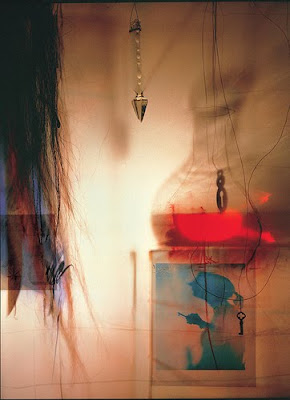
I have been a fan of Tracy Holland's photographer for some time. I have briefly written about her art. The work is complex or at least seems so. The maximalist, bricolage and mixed-media approach to image making is overwhelming. Each piece compresses a lot of narrative, memory and feeling. Usually the narrative is a fairy tale: a Brothers Grimm or Charles Perrault.
I am particularly fascinated by the combination of real objects and there traces: in shadow or projected. Some of the figures in Magic, Murder and the Weather recall the blueprint figure pictures that Rauschenberg did, usually in collaboration with Susan Weil, in the late 1940s and early fifties.
Above all her work shows what can be imaginatively done with photography in terms of how we interface with it.
 Three Cornered House installation 1992
 Incubus 1989
 'Green Earth's End' installation
The Twelve Keys:
 The Twelve Keys installation at Dean Clough, Halifax, U.K. 9 old window frames hung end to end with phtographic transparencies, objects, lights


Magic, Murder and the Weather:


Magic, Murder and the Weather installation shot, detail of What Came Picking Jessamine series
Eye of Heaven:

01 'Eye of Heaven' part i. installation shot at MAC
 Eye of Heaven series i no.01

Eye of Heaven series i no.02
The Almond Tree:
 'The Almond Tree' part i. lightbox image 01

'The Almond Tree' part i. lightbox image 02

'The Almond Tree' part i. lightbox image 03
 'The Almond Tree' part i. lightbox image 04

States of Matter exhibition Folly Gallery 'Elecro-Light' series
Resurrection Stories

Projection image 01-blood flow lungs and heart
 Projected image- Coral
 Projected still image 02 lungs
 Projected still Christ's Tear
Sources:
Tracy Holland's official site: http://www.traceyholland.co.uk/
I am particularly fascinated by the combination of real objects and there traces: in shadow or projected. Some of the figures in Magic, Murder and the Weather recall the blueprint figure pictures that Rauschenberg did, usually in collaboration with Susan Weil, in the late 1940s and early fifties.
Above all her work shows what can be imaginatively done with photography in terms of how we interface with it.
Three Cornered House
 Three Cornered House installation 1992
Mortal Remains
 Incubus 1989
 Green Earth's End
 'Green Earth's End' installation
The Twelve Keys:
 The Twelve Keys installation at Dean Clough, Halifax, U.K. 9 old window frames hung end to end with phtographic transparencies, objects, lights
Vessel:

'Vessel' installation panel image no.39

'Vessel' installation panel image no.13
Magic, Murder and the Weather:
Bluebeard series no.3

Bluebeard series no. 4
Bluebeard series no. 6

Magic, Murder and the Weather installation shot, detail of What Came Picking Jessamine series
Eye of Heaven:

01 'Eye of Heaven' part i. installation shot at MAC
Eye of Heaven series i no.01
Eye of Heaven series i no.02
The Almond Tree:
 'The Almond Tree' part i. lightbox image 01
'The Almond Tree' part i. lightbox image 02

'The Almond Tree' part i. lightbox image 03
 'The Almond Tree' part i. lightbox image 04
Electric Light Series
States of Matter exhibition Folly Gallery 'Elecro-Light' series
Resurrection Stories

Projection image 01-blood flow lungs and heart
 Projected image- Coral
 Projected still image 02 lungs
 Projected still Christ's Tear
Sources:
Tracy Holland's official site: http://www.traceyholland.co.uk/
My own review of the exhibition Magic, Murder and the Weather and Pat McCarthy's Now Wait for Last Year, (both commissioned by Leeds Metropolitan University Gallery 2001) can be seen at Culture Wars: http://www.culturewars.org.uk/2001-7/hollandmccarthy.htm
Current Developments: 3
The intention of this current project is to re-present visual mechanisms of hallucinations as described by M. H Keeler (1970). These examples seemed to be related to the descriptions of migraine auras which inspired a large body of my work. The aim is create a series of digital images that transform over a period of time to suggest a slowness of looking. The intention is to unify key interests: Collage/Digital Collage/Montage/Projections, Photographic material/found imagery, photogram imagery, with an idea of slow looking. Max Ernst is the catalyst for these ideas. His frottage pictures and the manner in which he observed his subjects serve as a kind of basis for experimentation and investigation. Ernst was partly inspired by the writing of Leonardo and his Treatise on painting and Max Ernt's own essay “Inspiration to Order” 1932.
Monday, 15 February 2010
Saturday, 13 February 2010
The ‘Architecture’ of the Web: Digital Utopias and Dystopias
"It’s a strange day
No colours or shapes
No sound in my head
I forget who I am
When I’m with you
There’s no reason
There’s no sense
I’m not supposed to feel
I forget who I am
I forget
Fascist baby
Utopia, utopia
My dog needs new ears
Make his eyes see forever
Make him live like me
Again and again
I’m wired to the world
That’s how I know everything
I’m super brain
That’s how they made me"
Utopia by Goldfrapp.
Ideas pertaining to the ‘modern movement’ in architecture can be used to inform many of the debates and ideas that now surround the World Wide Web, Web 2.0 and indeed Media Studies 2.0.
There is a sense of post-modern euphoria that we have broken free from the past and that old modernist theories are as redundant as their hierarchies of class, culture and taste, to name but three; we have reached some kind of e-topia. These utopian concepts partly came out of the sixties counter culture that reacted against modernism’s perceived authoritarianism- one thinks of Apple, a product of Californian sunshine and LSD, offering us an alternative world, a technological vision with a Byrdsian soundtrack, an alternative to the grey corporatism of the monolithic and historically dubious IBM. In eschewing modernist theories along with all the modernist inequities, are we in danger of throwing the theoretical baby out with the modernist bathwater?
In fact, the optimism surrounding the Internet and the World Wide Web as a communications tool has modernist utopian overtones, because modernism itself was, to many modernists, also a utopia. The web can be seen as a social condenser. The social condenser is a Soviet Constructivist theory about architectural space and how it has the ability to influence behaviour. Does not the ‘architecture’ of the WWW, a public space, break down perceived hierarchies and create an environment that allows and encourages communities to interact? Looked at this way, the computer becomes the liberation machine in a similar vein to modernism’s architectural ‘machines for living’ that were meant to somehow improve us.
There are also ideas pertaining to the pre-psychedelia, 1950s modernism of the International Typographical Style and its demand for clarity in design that are useful to us when trying to articulate the utopian nature of the Web. In web design Usability Heuristics demands similar things from its designers. The doctrine of usability suggests that with usability comes sociability.
With post-modern utopian notions of connectivity and the transcendence of national, institutional and political boundaries, are we being starry eyed in our optimism, or should we be harking back to the days of clean lines and Soviet-style functionality? The belief that new media benefit society through their attack on perceived hierarchies, and that the web is a great leveller, can be countered by the equally valid argument that the Web is undermining intellectual authority, generating failed spaces that are hostile, that threaten individual and collective security and help to circulate false information and dangerous ideas.
Is the computer best understood, then, with reference to modernist or post-modernist ideas of utopia's and dystopia's?
No colours or shapes
No sound in my head
I forget who I am
When I’m with you
There’s no reason
There’s no sense
I’m not supposed to feel
I forget who I am
I forget
Fascist baby
Utopia, utopia
My dog needs new ears
Make his eyes see forever
Make him live like me
Again and again
I’m wired to the world
That’s how I know everything
I’m super brain
That’s how they made me"
Utopia by Goldfrapp.
Ideas pertaining to the ‘modern movement’ in architecture can be used to inform many of the debates and ideas that now surround the World Wide Web, Web 2.0 and indeed Media Studies 2.0.
"1984" Apple Macintosh Advertisement directed by Ridley Scott
There is a sense of post-modern euphoria that we have broken free from the past and that old modernist theories are as redundant as their hierarchies of class, culture and taste, to name but three; we have reached some kind of e-topia. These utopian concepts partly came out of the sixties counter culture that reacted against modernism’s perceived authoritarianism- one thinks of Apple, a product of Californian sunshine and LSD, offering us an alternative world, a technological vision with a Byrdsian soundtrack, an alternative to the grey corporatism of the monolithic and historically dubious IBM. In eschewing modernist theories along with all the modernist inequities, are we in danger of throwing the theoretical baby out with the modernist bathwater?
In fact, the optimism surrounding the Internet and the World Wide Web as a communications tool has modernist utopian overtones, because modernism itself was, to many modernists, also a utopia. The web can be seen as a social condenser. The social condenser is a Soviet Constructivist theory about architectural space and how it has the ability to influence behaviour. Does not the ‘architecture’ of the WWW, a public space, break down perceived hierarchies and create an environment that allows and encourages communities to interact? Looked at this way, the computer becomes the liberation machine in a similar vein to modernism’s architectural ‘machines for living’ that were meant to somehow improve us.
There are also ideas pertaining to the pre-psychedelia, 1950s modernism of the International Typographical Style and its demand for clarity in design that are useful to us when trying to articulate the utopian nature of the Web. In web design Usability Heuristics demands similar things from its designers. The doctrine of usability suggests that with usability comes sociability.
With post-modern utopian notions of connectivity and the transcendence of national, institutional and political boundaries, are we being starry eyed in our optimism, or should we be harking back to the days of clean lines and Soviet-style functionality? The belief that new media benefit society through their attack on perceived hierarchies, and that the web is a great leveller, can be countered by the equally valid argument that the Web is undermining intellectual authority, generating failed spaces that are hostile, that threaten individual and collective security and help to circulate false information and dangerous ideas.
Is the computer best understood, then, with reference to modernist or post-modernist ideas of utopia's and dystopia's?
Friday, 12 February 2010
Cyberspace

"A year here and he still dreamed of cyberspace, hope fading nightly. All the speed he took, all the turns he'd taken and the corners he'd cut in Night City, and still he'd see the matrix in his sleep, bright lattices of logic unfolding across that colorless void."
– Neuromancer
Cyberspace has more literary origins. According to The Columbia Dictionary of Modern Literary and Cultural Criticism (1995) describes cyberspace as a “virtual world” that “is being developed through the interface of the human mind and computer technology. It is an electronically defined world in which a human can experience an environment completely outside the one that he or she physically occupies. The term was coined by the science fiction writer William Gibson in his novel Neuromancer, although his imaginative rendition of the concept is a good deal ahead of the technology presently available and more dystopian than most writing on the subject. (Kostelanetz, R., 2001 p. 152)
Source:
Kostelanetz, R (2001) Dictionary of Avant-gardes (2nd Edition) New York: Routledge
Wednesday, 3 February 2010
From Leonardo’s "Treatise on Painting"
“When you look at a wall spotted with stains, or with a mixture of stones, if you have to devise some scene you may discover a resemblance to various landscapes … or, again, you may see battles and figures in action, or strange faces and costumes, or an endless variety of objects, which you could reduce to complete and well-drawn forms. And these appear on such walls promiscuously, like the sound of bells in whose jangle you may find any name or word you choose to imagine”.
Subscribe to:
Posts (Atom)